EPDS: History, Science, & Why It's the Gold Standard
Becoming a parent changes everything—in the best and toughest ways. It's filled with moments of incredible joy and deep love, but it can also bring unexpected emotional challenges. Many new and expecting parents find themselves grappling with feelings that are more complex than the simple "baby blues." But how can you tell the difference between normal stress and something more?
For decades, healthcare professionals have relied on a trusted tool to help answer this question: the Edinburgh Postnatal Depression Scale (EPDS). This article explores the history and science behind the EPDS, explaining why it has become the global gold standard for perinatal mental health screening. Understanding this powerful tool is the first step toward taking control of your emotional well-being. You can begin that journey today with a confidential online EPDS screening.
The Birth of EPDS: A Historical Overview
The EPDS wasn't created overnight. It was born from a clear need for a better way to support mothers during the vulnerable perinatal period—the time during pregnancy and the year after birth. Before its development, many cases of perinatal depression went unrecognized and untreated.
Who Developed the EPDS and Why Was It Needed?
In 1987, researchers John Cox, Jeni Holden, and Ruth Sagovsky from Edinburgh, United Kingdom, developed the Edinburgh Postnatal Depression Scale. Standard depression tests missed the mark for new moms. They couldn't distinguish real symptoms from the normal stress and fatigue of caring for a newborn.
The goal? A simple questionnaire to spot postpartum depression fast. It needed to detect symptoms reliably—without causing false alarms. The result was a 10-question scale that has since helped millions of women worldwide.
Evolution and Early Adoption of the Edinburgh Postnatal Depression Scale
The EPDS quickly gained respect within the medical community for its accuracy and simplicity. Healthcare providers, from midwives to general practitioners, began using it as a routine part of postpartum care. Its success led to its translation into dozens of languages and its validation in numerous cultures.
Over the years, the scale's use has expanded beyond just the postpartum period. It is now widely used to screen for depression during pregnancy as well. This early detection allows for timely support, helping to improve outcomes for both the parent and the baby.
Unpacking the Science: How the EPDS Questionnaire Works
The strength of the EPDS lies in its carefully constructed design. It’s not just a random list of questions; it's a scientifically validated instrument designed to measure your emotional state over the past seven days. This approach provides a relevant and current snapshot of your mental health.
Understanding the 10 Questions: What Does EPDS Measure?
The EPDS questionnaire consists of 10 short questions. Each one explores a different facet of your emotional well-being. The questions are designed to be non-judgmental and focus on common symptoms of perinatal mood disorders.
They cover topics such as:
- Your ability to experience pleasure (anhedonia)
- Feelings of self-blame or guilt
- Anxiety and worry
- Feelings of panic or being overwhelmed
- Difficulty sleeping
- Feelings of sadness or misery
- Thoughts of self-harm
By covering this range of symptoms, the EPDS provides a more complete picture than a simple question like, "Do you feel sad?" It acknowledges that perinatal depression is a complex condition with many different signs.
The Scoring System: How EPDS Identifies Potential Risk
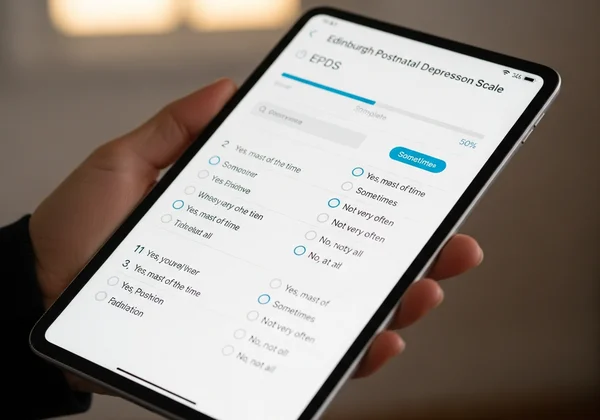
Each of the 10 questions has four possible answers, which are scored on a scale from 0 to 3. The higher the score, the more significant the symptom. After you complete the questionnaire, the scores for all 10 questions are added together to produce a final score out of a possible 30.
Your total score flags depressive risk levels. Remember: It's not a diagnosis—just a signal to talk to a pro. A higher score suggests a greater need to speak with a healthcare professional for a formal evaluation. Understanding your risk level is a crucial first step, and you can get your score in just a few minutes.
Validating the Gold Standard: Reliability and Effectiveness of EPDS
For any screening tool to be useful, it must be reliable and effective. The EPDS has been the subject of hundreds of studies over more than three decades, all of which have cemented its reputation as a trustworthy instrument in perinatal care.
Proven Efficacy: Sensitivity and Specificity of EPDS
Two key measures of a screening tool's effectiveness are its sensitivity and specificity.
- Sensitivity refers to its ability to correctly identify people who do have the condition (in this case, depression). The EPDS has high sensitivity, meaning it is very good at catching potential cases.
- Specificity refers to its ability to correctly identify people who do not have the condition. The EPDS also scores well here, meaning it doesn't create false alarms too often.
This balance makes the EPDS a highly effective tool. It successfully flags most individuals who need further support while minimizing unnecessary worry for those who don't.

EPDS vs. Other Scales: Why It Remains Preferred for Perinatal Care
While other depression screening tools exist, such as the Patient Health Questionnaire (PHQ-9), the EPDS remains the gold standard for perinatal populations. This is because it was specifically designed for and validated on pregnant and postpartum women.
The questions are tailored to the unique context of new parenthood. For example, it avoids questions about changes in appetite or sleep that can be normal during this life stage, focusing instead on emotional symptoms. This specificity makes it a more accurate and relevant tool for mothers and birthing parents.
Beyond the Score: Responsible Use and Limitations of EPDS
While the EPDS is an invaluable tool, it's essential to understand its role and its limitations. A score is just a number; what you do with that information is what truly matters for your health.
EPDS as a Screening Tool, Not a Diagnostic Instrument
This is the most critical point to remember: the EPDS is a screening tool, not a diagnostic one. It cannot tell you for certain that you have depression. Only a qualified healthcare professional, like a doctor or a therapist, can provide a formal diagnosis after a comprehensive evaluation.
Think of the EPDS score as a conversation starter. It gives you objective information to share with your provider, helping you explain how you've been feeling. It empowers you to seek help with confidence. If you're ready to take that first step, you can start your screening now.

Addressing Cultural Nuances and Individual Differences in EPDS Screening
Mental health is experienced and expressed differently across cultures. The developers of the EPDS and subsequent researchers have recognized this, which is why the scale has been translated and validated in over 50 languages. This ensures that it is a relevant and effective tool for people from diverse backgrounds.
On our platform, we are committed to this global accessibility. Our online screening is available in 16 languages, helping to ensure that anyone, anywhere, can access this vital first step in perinatal mental health care.
Empowering Your Perinatal Mental Health Journey with EPDS
For over 30 years, the Edinburgh Postnatal Depression Scale has been a trusted ally for new parents and healthcare providers. Its rich history, scientific validation, and practical effectiveness have made it the global gold standard for a reason. It provides a clear, reliable, and compassionate way to check in on your emotional well-being during one of life's most demanding transitions.
Understanding your EPDS score isn't about getting a label; it's about gaining insight. It is an empowering step that helps you advocate for your own health and get the support you deserve. Your mental health is just as important as your physical health.
Take a moment for yourself today. A few minutes is all it takes to gain valuable insight and take the first step toward feeling better.
Start Your Free, Confidential EPDS Screening Now
Frequently Asked Questions About the EPDS
What is EPDS and what does it screen for?
The EPDS, or Edinburgh Postnatal Depression Scale, is a 10-question self-assessment tool used to identify individuals who may be at risk for perinatal depression. This includes depression during pregnancy and in the year following childbirth. It also helps detect symptoms of related anxiety disorders.
How effective is the EPDS in identifying perinatal depression?
The EPDS is highly effective. Decades of studies prove its power. High sensitivity catches those who need help. High specificity avoids false alarms. It is considered the gold standard for perinatal depression screening worldwide.
What is a normal EPDS score, and what should I do with my results?
Scores can range from 0 to 30. Generally, a score below 9 or 10 is considered in the low-risk range. However, there is no single "normal" score, as every individual is different. Regardless of your score, if you are concerned about your mental health, the most important step is to discuss your results with a healthcare provider.
Is the EPDS test offered by this platform free and confidential?
Yes. The screening tool here is completely free and confidential. We believe everyone deserves access to mental health resources. No registration is required, and your privacy is our priority. You can try our free tool with peace of mind.
How long does the online EPDS test take to complete?
The online EPDS screening is designed to be quick and easy. Most people complete the 10 questions in just 3 to 5 minutes. The goal is to provide a fast, accessible way for you to check in on your emotional well-being without adding stress to your busy life.