EPDS AI Report: Uncovering Personalized Perinatal Insights
Welcoming a new baby is a profound experience, filled with moments of joy, love, and wonder. But for many new parents, this period also brings unexpected emotional challenges. The Edinburgh Postnatal Depression Scale (EPDS) is a vital first step to assess your mental well-being. However, a single score rarely tells your full story.
What if you could see the unique patterns behind your feelings? The standard EPDS provides a number, but what does that number truly mean for you? At Epds.me, we believe in a deeper level of understanding. Our innovative AI-powered analysis goes beyond a generic score to provide deeply personalized insights. It helps you navigate your mental health journey with greater clarity and confidence.
This article explores how our unique AI report transforms a simple screening into a powerful tool for self-awareness. Discover how you can move beyond the score and gain a clearer picture of your emotional landscape. To see how it works, you can begin your confidential EPDS test at any time.
What is the EPDS AI Analysis & How Does It Work?
Many people are familiar with the 10-question EPDS screening. You answer the questions and receive a score. But our AI analysis is the crucial next step that turns that data into a personalized narrative. It’s designed to offer clarity where a single number might create confusion.
Beyond the Basic EPDS Score: Limitations of Traditional Interpretation
A traditional EPDS score is an excellent indicator. It tells you if you might be at risk for perinatal depression or anxiety. However, it has limitations. For example, two people can get the exact same score of "15" for entirely different reasons. One person might be struggling with overwhelming guilt and low mood, while another might be experiencing intense anxiety and sleeplessness.
A basic score can't distinguish between these nuances. It doesn't highlight your specific symptom patterns, explain how different feelings might be connected, or offer context for your experience. You can learn about EPDS scoring and how our analysis provides this deeper context. This is where a more advanced approach becomes invaluable. It’s the difference between knowing your temperature and understanding what’s causing the fever.
How Our AI Algorithm Processes Your Responses
Our AI analysis isn't magic; it's smart technology designed with empathy. Once you finish the EPDS questionnaire, opt for the AI report. Our secure algorithm then analyzes your responses for deeper patterns. It looks for subtle connections and patterns that a simple score calculation would miss.
Here’s a simple breakdown of what it does:
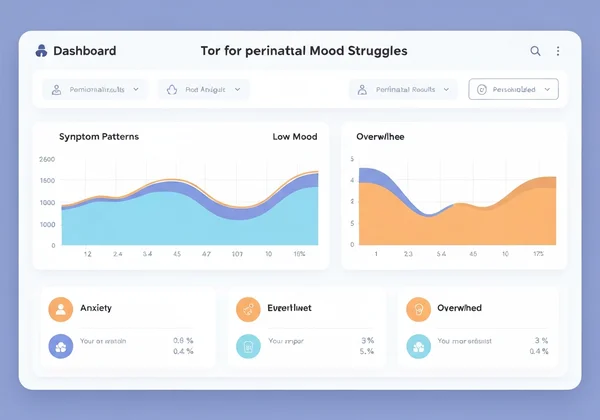
- Pattern Recognition: The AI identifies which groups of symptoms are most prominent for you. For instance, it can detect if your responses point more strongly toward anxiety, low mood, or feelings of being overwhelmed.
- Contextual Analysis: By cross-referencing your answers, the AI can suggest how certain feelings might be linked. It might highlight a potential connection between your sleep quality and your ability to feel pleasure in your day.
- Strength Identification: The report doesn’t just focus on challenges. It can also point out areas of resilience based on your responses, providing a more balanced and empowering perspective.
The entire process is confidential and anonymous. The goal is to provide you with objective, data-driven insights that reflect your personal experience.

How Our AI Analysis Aligns with Clinical EPDS Standards
The EPDS is a globally recognized, clinically validated tool. Our AI doesn't change the scale's fundamental integrity; it enhances it. The analysis is built on established psychological principles and cross-references vast datasets of anonymized response patterns to ensure its insights are both relevant and grounded in clinical understanding. This approach ensures you're receiving feedback that aligns with professional standards, making it a credible resource to share with your healthcare provider.
Personalized Depression Screening: Tailored Insights for You
The true power of the AI report lies in its personalization. It transforms the EPDS from a generic questionnaire into a tool for personalized depression screening, giving you insights that are tailored specifically to your life and your feelings.
Identifying Unique Symptom Patterns: From Sleep Changes to Guilt
Perinatal mood struggles are not one-size-fits-all. They manifest in many ways, including sadness, irritability, worry, and difficulty bonding. Our AI analysis helps you see your unique emotional signature.
For example, your report might reveal:
- Anxiety-Dominant Profile: Your score might be elevated primarily due to answers related to worry and feeling anxious, even if you don't feel particularly "sad."
- Overwhelm and Self-Criticism: The AI could identify a strong link in your answers between feeling overwhelmed and intense self-blame, a common but often unspoken struggle for new parents.
- Physical Manifestations: The analysis may highlight how much physical symptoms, like sleeplessness or lack of energy, are contributing to your overall emotional state.
By pinpointing these specific patterns, the report gives you a clearer language to describe what you're feeling, both to yourself and to others. You can unlock your personalized AI report to learn more about your own patterns.
Understanding Your Scores Within Your Unique Life Context
Your journey through parenthood is unique. The optional background information you can provide allows the AI to place your results in a more relevant context, making the insights even more accurate and helpful.
This doesn't change your core EPDS score, but it enriches the narrative around it. For instance, knowing that you have a history of anxiety or are a first-time parent allows the AI to frame its observations in a way that feels more relevant to your situation. This level of personalization ensures the report is not just data, but a truly helpful guide tailored to your circumstances.
EPDS AI Reports: Empowering Reluctant Help-Seekers
One of the biggest hurdles in mental health is the step between feeling that something is wrong and seeking help. Stigma, self-doubt, and the fear of being judged can be powerful barriers. EPDS AI reports are designed to be a gentle, objective bridge over that gap.
Objective Data to Overcome Stigma and Self-Doubt
It's common for new parents to dismiss their struggles. They might think, "I'm just tired," "This is normal for new moms," or "I shouldn't complain." Self-doubt can prevent them from recognizing the significance of their feelings.
An AI report offers objective data. It's not a person judging you; it's a tool reflecting the information you provided. Seeing your feelings laid out in a clear, structured report can be incredibly validating. It confirms that what you're experiencing is real and significant. This validation can provide the confidence needed to silence the inner critic and acknowledge that you deserve support.
Guiding Your First Steps Towards Professional Support
Acknowledging you need support is tough. Knowing how to seek it? Even tougher. An AI-driven report can make that first conversation with a doctor, therapist, or partner much less daunting.
The report provides a concise summary of your key symptom patterns. You can use this as a starting point for discussion, saying something like, "I took an online screening, and the analysis showed I'm struggling a lot with anxiety and feelings of guilt. Can we talk about this?" It gives you specific points to discuss, turning a vague feeling of "not being okay" into a concrete conversation about your health.

EPDS AI Insights in Practice: Real User Stories
The following anonymized scenarios illustrate common user experiences. Outcomes are hypothetical and based on generalized EPDS response patterns.
To truly appreciate the benefit of AI analysis, let's look at some anonymized examples based on common user experiences. These stories show how insights can lead to real-world understanding and action.
Case Study: The New Mom Battling Overwhelm and Isolation
A new mother named Sarah felt completely overwhelmed. She loved her baby but felt she was failing at everything. She took the screening and got a score of 14, indicating a risk of depression. She felt lost.
Her AI report, however, revealed a crucial insight. While her mood was low, her highest-scoring answers were related to self-blame and feeling unable to cope. The AI identified a dominant pattern of "overwhelm leading to isolation." The report suggested that her core struggle wasn't just sadness, but a critical lack of support and immense pressure she put on herself. This clarity helped Sarah have a specific conversation with her partner. Instead of just saying "I'm sad," she could say, "I feel like I'm failing because I'm doing everything alone." This led to practical changes that significantly eased her burden.
Case Study: Recognizing Anxiety Beyond Traditional Depression Signs
Another user, Emily, didn't feel "depressed" in the classic sense. She wasn't crying all the time. Instead, she was constantly on edge, her heart raced, and she couldn't sleep for fear something would happen to the baby. Her EPDS score was 11, which is in a gray area.
The AI analysis was key. It flagged a strong cluster of anxiety-related symptoms that were driving her score. The report specifically identified patterns of "hypervigilance and persistent worry." For Emily, this was a lightbulb moment. She realized she was suffering from postpartum anxiety, not depression. This insight allowed her to seek the right kind of help, focusing on techniques to manage anxiety and intrusive thoughts. You too can discover your unique symptom patterns with our confidential screening.
"Dr. Samuel Green, OB/GYN: 'AI-enhanced EPDS reports empower patients to articulate symptoms more effectively during consultations.'"
Unlock Deeper Understanding: Your Next Steps with EPDS.me
Your emotional health as a new parent is incredibly important. A simple number from a screening is a good start, but it's not the end of the story. The real power comes from understanding the nuances behind that score.
An EPDS AI report offers a story—your story. It provides personalized insights that can validate your feelings, reduce self-doubt, and give you a clear, actionable path forward. It empowers you with the knowledge you need to have more effective conversations with your support system and healthcare providers.
Your emotions matter. Use your EPDS score as a starting point—not an endpoint—to advocate for your mental well-being. Take the free EPDS screening online on our homepage today and choose to unlock your personalized AI report.

EPDS AI Report FAQ: Clinical Insights and Next Steps
How effective is EPDS, and how does AI enhance it?
The EPDS is a clinically validated and highly effective screening tool used worldwide to identify symptoms of perinatal depression and anxiety. Our AI technology enhances its effectiveness by providing a deeper, personalized analysis of the results, helping you understand the specific patterns and context behind your score.
What is a normal EPDS score when considering AI insights?
Generally, a score under 10 is considered low-risk, but there's no single "normal" for everyone. Your AI report translates your EPDS score into actionable insights tailored to your symptoms. For example, a lower score might still reveal a specific struggle with anxiety that warrants attention. The goal of the AI is to provide insight regardless of the number.
Is the EPDS AI report free, or does it cost extra?
The initial EPDS screening and your basic score are completely free. The detailed, AI-driven report is an optional premium feature that provides the in-depth analysis discussed in this article. You can decide if you want this deeper insight after you review your EPDS score and analysis.
How long does the EPDS test take to get an AI report?
The EPDS questionnaire itself is very quick, typically taking only 3 to 5 minutes to complete. If you choose to receive the AI analysis, your personalized report is generated and ready to view almost instantly after you finish.
What to do after receiving a high EPDS score with AI analysis?
A high score and an insightful AI report are important first steps, not a diagnosis. The most crucial next step is to share these results with a healthcare professional, such as your OB/GYN, a family doctor, or a mental health therapist. Your report can serve as an excellent starting point for that important conversation.