Edinburgh Postnatal Depression Scale CPT Code: 96160, 96161, 96127, and G0444 Explained
If you are looking for the Edinburgh Postnatal Depression Scale CPT code, the honest answer is that it depends on who completes the scale, whose benefit the screening serves, and which payer policy applies. EPDS is a perinatal depression screening tool, but CPT and HCPCS codes describe the service context, not just the name of the questionnaire. A private, educational EPDS self-reflection tool can help patients understand the scale experience, while clinical billing still belongs to the provider, payer contract, and current coding guidance. This guide explains the common code choices, where 96160, 96161, 96127, G0444, and G8431 fit, and what documentation usually needs to show.

The Short Answer: EPDS Coding Is Context-Based
For many pregnant or postpartum patients completing EPDS for themselves, coding references commonly point to CPT 96160, a patient-focused health risk assessment service with scoring and documentation. In pediatric settings, when a parent or caregiver completes a depression inventory for the benefit of the child during an infant visit, CPT 96161 is often discussed. CPT 96127 may appear when the service is treated as a brief emotional or behavioral assessment, especially for depression or anxiety screening tools, but payer rules vary.
Medicare annual depression screening often uses HCPCS G0444 rather than 96127. G8431 is different again: it is a quality reporting code that indicates a positive depression screen with a follow-up plan documented. It is not the same thing as the administration code for the EPDS itself.
That is why a clean answer such as "EPDS always equals 96160" is too broad. A better working question is: who is being assessed, for whose benefit, and under which payer rule?
How 96160 Fits EPDS Screening
CPT 96160 is commonly used for a patient-focused health risk assessment instrument when the patient completes a standardized tool and the result is scored and documented. In an obstetric, family medicine, or primary care context, EPDS is often viewed this way when the pregnant or postpartum patient is the person being screened.
Practical examples may include:
- A postpartum patient completes EPDS at a postpartum visit.
- A pregnant patient completes EPDS during prenatal care.
- The practice records the instrument name, score or result interpretation, date, and follow-up discussion.
The key is that the service is not merely a casual mood question. It should involve a standardized instrument, scoring, and documentation. If EPDS is collected but no score, interpretation, or care-related note is documented, billing support becomes weaker.
96160 Documentation Requirements
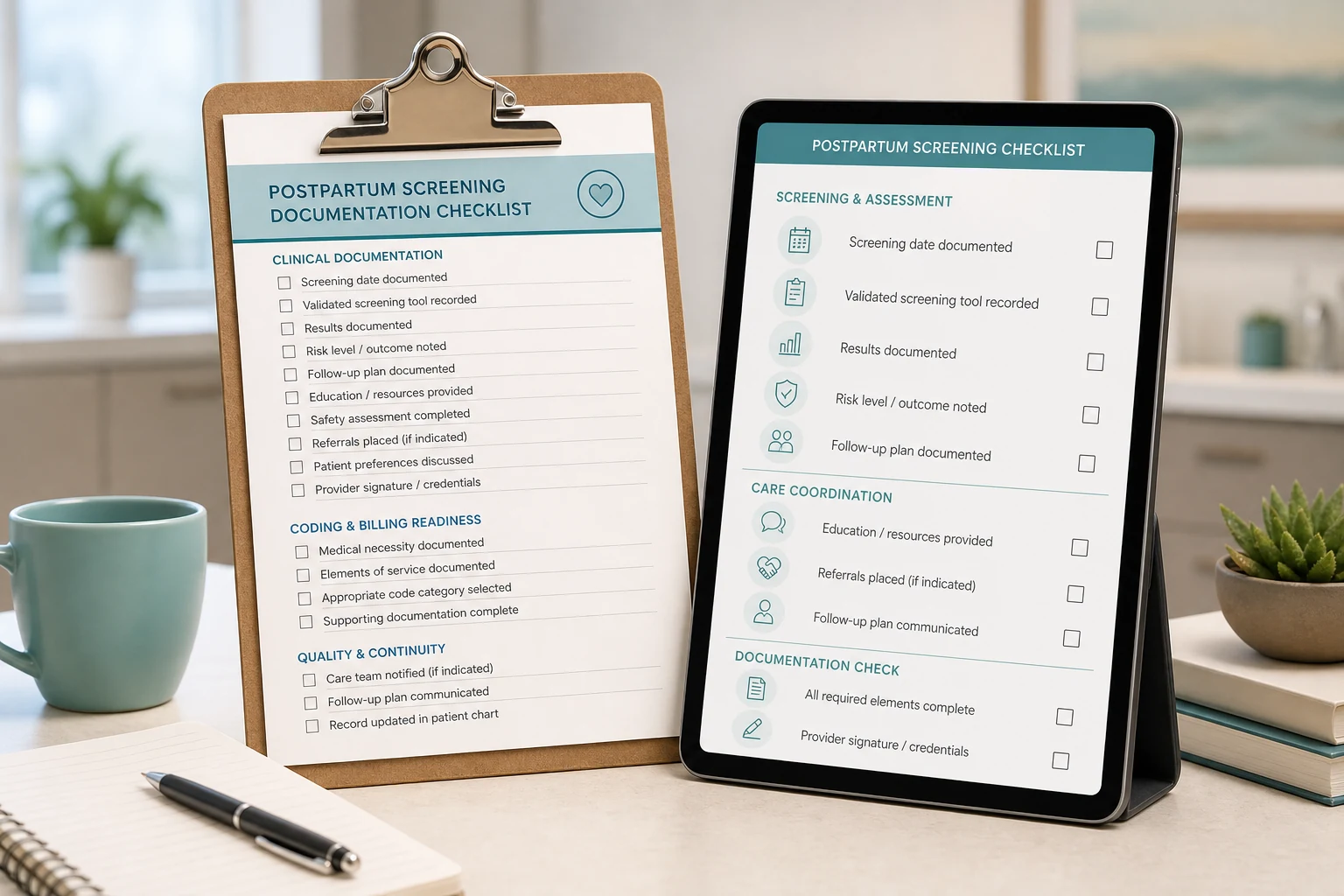
Documentation expectations vary by payer, but the note should usually make the service visible. A careful record may include:
- Name of the tool, such as Edinburgh Postnatal Depression Scale or EPDS.
- Who completed it and when.
- Score, risk category, or positive/negative screening result according to the practice's policy.
- Confirmation that the result was reviewed by the clinician or care team.
- Any follow-up plan, referral, safety assessment, or patient education when appropriate.
- The visit context and any separately identifiable evaluation and management work if an E/M service is billed too.
Some payers may ask for modifier 25 on a related E/M code when the visit work is separate and medically necessary. That is different from saying every 96160 claim needs the same modifier. Modifier rules are payer-specific, so the safest approach is to check the payer manual and current edits before assuming.
When 96161 May Be the Better Fit
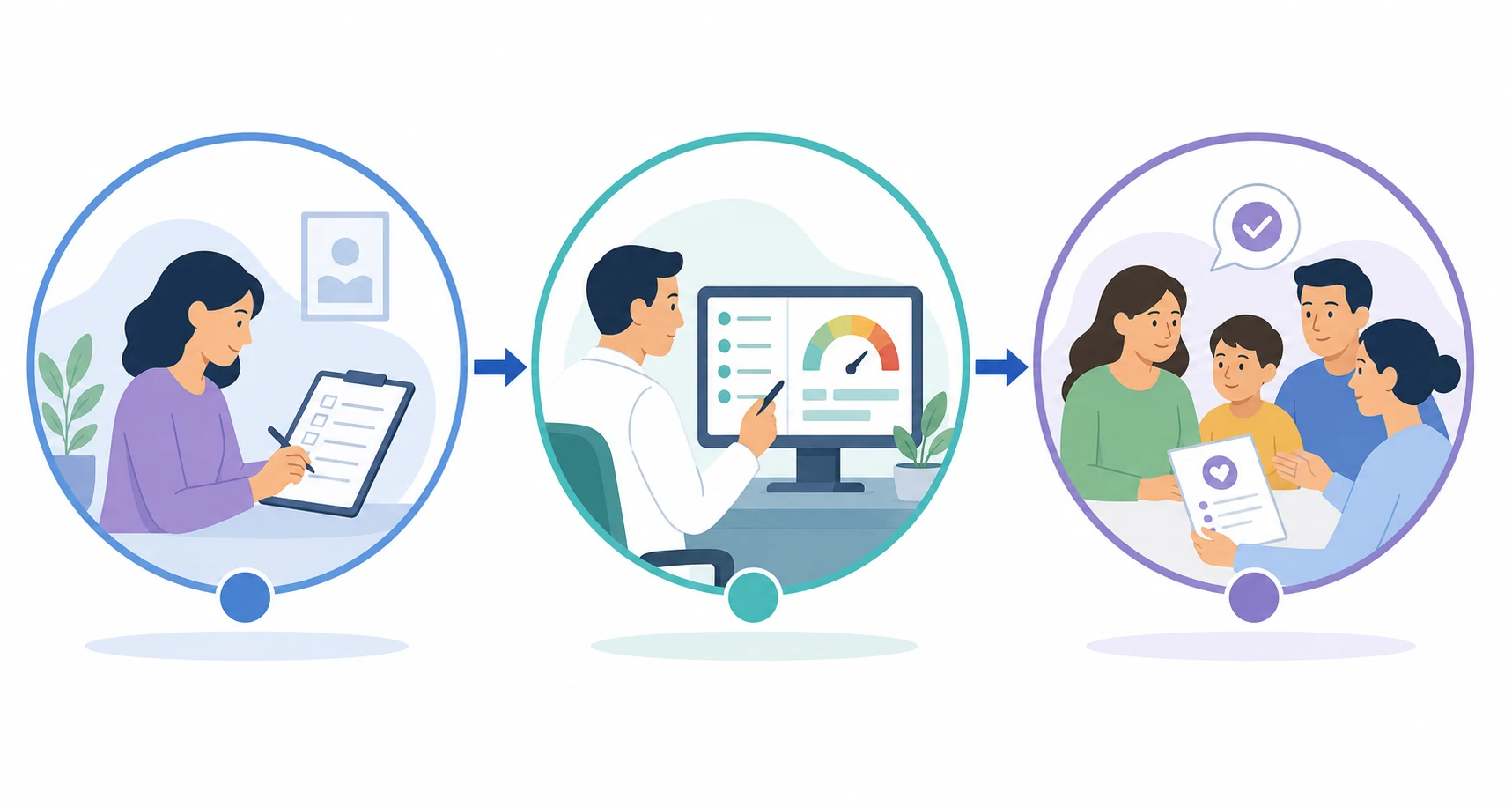
CPT 96161 is used for a caregiver-focused health risk assessment performed for the benefit of the patient. In postpartum depression workflows, this often appears in pediatric care: the infant is the patient, but the mother or caregiver completes a depression inventory because caregiver mental health affects the infant's care environment.
This is why 96161 often comes up during well-baby visits. The screening is about the caregiver, but the service is connected to the child's health and development. Many Medicaid and pediatric policies discuss this pathway, and some limit frequency, timing, or age windows.
96161 Description and Age Limit Questions
Searchers often ask about a 96161 age limit. The important point is that the CPT code description itself is broader than a single age number, but payer policies may create age, visit type, or frequency limits. For example, a Medicaid program may allow maternal depression screening at specific infant well-child visits, while another payer may set a different window.
For billing teams, the question should not be "what universal age limit applies everywhere?" It should be "what does this payer allow for caregiver-focused screening tied to this patient's visit?"
Where 96127 Comes In
CPT 96127 is associated with brief emotional or behavioral assessment using a standardized instrument, with scoring and documentation. It is often discussed for depression, anxiety, ADHD, and similar tools. Because EPDS is a depression screening instrument, some practices and payers may route a perinatal depression screen through 96127, especially when the payer policy groups depression inventories under emotional or behavioral assessment.
However, 96127 is not automatically the best EPDS code in every setting. For pregnant or postpartum patients, several coding references and payer examples point toward 96160. For caregiver screening in pediatrics, 96161 may be the better match. For general depression or anxiety screening outside perinatal-specific workflows, 96127 may be more familiar.
If your team uses an online EPDS screening experience to understand the patient flow, remember that billing codes still attach to the clinical encounter, documentation, payer rule, and professional workflow.
96127 Versus G0444
The difference between CPT 96127 and HCPCS G0444 is mostly payer and benefit context. CPT 96127 is a broader brief emotional or behavioral assessment code. G0444 is used for Medicare annual depression screening in eligible primary care settings.
A Medicare annual depression screen may therefore belong under G0444 instead of 96127. Other payers may handle depression screening differently. This is one reason articles that list only "depression screening CPT codes" can be misleading unless they explain payer context.
What G8431 Means
G8431 is not the CPT code for administering EPDS. It is a quality reporting code used when depression screening is documented as positive and a follow-up plan is documented. It often appears in quality measures, HEDIS-like workflows, or MIPS-related reporting.
In plain English, G8431 answers a different question:
- Administration code question: what service was performed?
- Quality reporting question: was the depression screen positive, and was follow-up documented?
That means a claim or quality workflow may involve both a screening service code and a result or quality code, depending on payer and measure requirements. A negative result may use a different quality code in some programs.
A Simple Decision Framework
Use this framework as an educational starting point, not a substitute for payer review.
| Clinical situation | Common code direction | Why it may fit |
|---|---|---|
| Pregnant or postpartum patient completes EPDS for herself | 96160 | Patient-focused health risk assessment |
| Caregiver completes depression inventory during infant care | 96161 | Caregiver-focused assessment for the patient's benefit |
| Brief depression or anxiety inventory in a behavioral screening workflow | 96127 | Emotional or behavioral assessment |
| Medicare annual depression screening | G0444 | Medicare-specific annual depression screening benefit |
| Positive depression screen with documented follow-up for quality reporting | G8431 | Quality/result reporting, not instrument administration |
The table is intentionally cautious because payer manuals, state Medicaid guidance, managed care contracts, and National Correct Coding Initiative edits can change how a code is accepted.
Common Billing Mistakes to Avoid
The first mistake is coding the tool name instead of the service. EPDS is the instrument; 96160, 96161, 96127, or G0444 describes the service context. The same instrument can appear in different clinical settings.
The second mistake is overlooking who benefits. If the postpartum patient is being screened for her own care, that points one way. If a caregiver screen is performed because the infant is the patient at a pediatric visit, that may point toward 96161.
The third mistake is weak documentation. "EPDS done" is usually less useful than a note showing the instrument, score or screening result, review, and follow-up plan when needed.
The fourth mistake is assuming reimbursement from code selection alone. A code can be valid and still be denied because of payer frequency limits, missing modifiers, diagnosis pairing, age rules, or bundling edits.
How EPDS Results Should Be Handled Safely
EPDS is a screening tool. It can flag that more support or evaluation may be appropriate, but it does not replace a full clinical assessment. This matters both for patient communication and for documentation. A high score should be handled with care, privacy, and appropriate follow-up, especially if self-harm responses or urgent safety concerns are present.
For patient-facing communication, gentle wording helps. A clinician might say the score suggests it would be wise to talk more about mood, sleep, support, and safety. That is less frightening and more useful than making absolute claims from a screening number.
For documentation, the record should show that the result was reviewed and addressed according to the practice's policy. If the screen is positive, quality programs may expect a follow-up plan, such as referral, additional evaluation, support resources, or other appropriate next steps.
Before You Choose an Edinburgh Postnatal Depression Scale CPT Code
Before choosing an Edinburgh Postnatal Depression Scale CPT code, gather the basic facts: setting, payer, patient, person completing the form, purpose of the screen, visit type, result, and follow-up. Then compare those facts with the payer's current rules.
For education, a private EPDS score reflection resource can help people understand what the questions feel like and why scoring needs careful interpretation. For billing, the final decision should come from current coding resources, payer policy, and the clinician's documentation.
The most useful takeaway is not a single magic code. It is a clean decision path: EPDS for the postpartum patient often points to 96160, caregiver screening for an infant visit often points to 96161, broader emotional or behavioral screening may involve 96127, Medicare annual depression screening may use G0444, and G8431 reports a positive screen with follow-up in quality workflows.
FAQ
What is the CPT code for the Edinburgh Postnatal Depression Scale?
There is no one code that fits every EPDS use. In many pregnant or postpartum patient workflows, 96160 is commonly used. In pediatric caregiver screening, 96161 may apply. Some payers may use 96127 for brief emotional or behavioral assessment. Always check payer policy and documentation requirements.
What is the difference between CPT 96160 and 96161?
96160 is patient-focused: the assessment is for the person completing it. 96161 is caregiver-focused: the caregiver completes the assessment for the benefit of the patient, such as an infant in a pediatric visit.
Is CPT 96127 the same as G0444?
No. 96127 is a CPT code for brief emotional or behavioral assessment with scoring and documentation. G0444 is a Medicare HCPCS code for annual depression screening in eligible primary care settings.
Does CPT code 96160 need a modifier?
Not always. Some payers may require modifier 25 on a same-day E/M service when the visit is separately identifiable. Other payer rules may differ. Check the payer policy instead of applying one modifier rule to every claim.
What documentation supports CPT 96160?
Useful documentation usually includes the standardized instrument name, completion date, score or result, review by the care team, and any follow-up plan when appropriate. The note should show that the screening was scored and documented, not just handed to the patient.
What is CPT 96161 used for in postpartum screening?
96161 is commonly discussed when a caregiver, often a mother, completes a depression inventory for the benefit of the child during pediatric care. Payer policies may limit timing, frequency, or eligible visit types.
What is G8431?
G8431 is a quality reporting code indicating that depression screening was positive and a follow-up plan was documented. It does not replace the CPT or HCPCS code used to report the screening service itself.